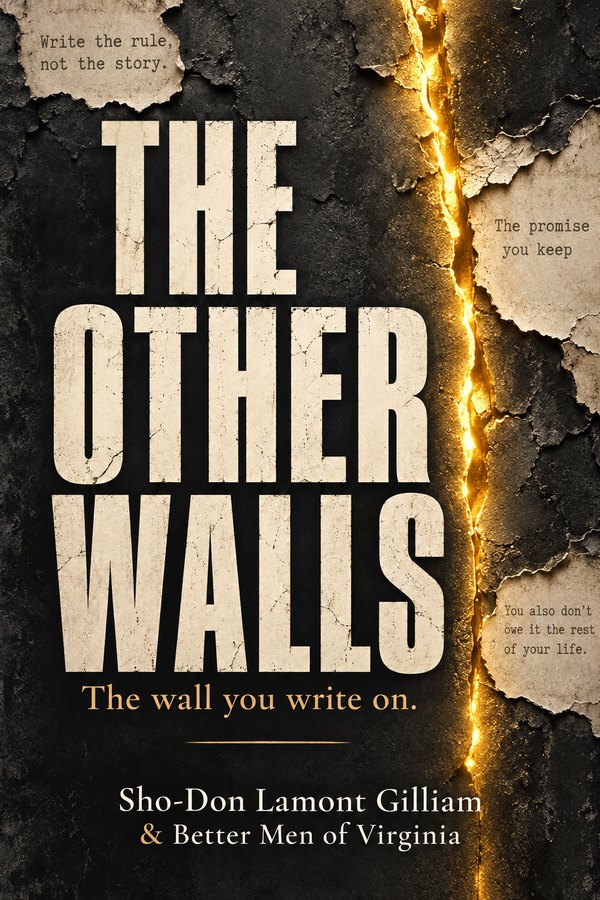
The Other Walls
Every room you have lived in had rules on its walls. Most were never written down. You learned them anyway, in your shoulders and your jaw, and some of them walked out the door with you.
A workbook for noticing old rules, keeping small promises, and choosing what comes next. Free. No sign-up.
Three ways, same book. Write on this page, fill in the PDF on your own phone or computer and keep the file, or print it and use a pen. The fillable file lives wherever you save it. BMV never sees it.
How this book works
A kitchen, a corner, a classroom, a cell. Each one taught you what was allowed inside it, and you learned fast because you had to. Those rules kept you on your feet. Some of them still run when you walk into a room where they don’t fit anymore.
Three rules, and they don’t bend.
- Write the rule, not the story. You do not have to put down what happened to you. One line about what you learned to do is enough.
- Yours alone. BMV never collects, copies, or reads this book. Nobody in the house has a right to see it. Show it to someone only if you choose to.
- Stop when it gets heavy. If a page brings up more than you can carry, close the book. That is allowed. Call or text 988 any time, day or night, or ask staff to connect you with a counselor. This book is not treatment and it does not replace it.
Take one part at a time. There is no order you have to follow and no date you have to finish by.
Where your words go
Nowhere. This page has no account and no sign-up, and nothing you type is ever sent to BMV or anyone else.
The page does count how many times the book is opened, downloaded, and shared. It sends a single tick, like a turnstile click: which button, and which day. Never your name, your phone, where you are, or a word you wrote.
By default, what you type disappears when you close the page. If this is your own phone, you can choose to keep it here, on this phone only, until you erase it.
On a shared phone or a library computer, leave this off, or press Erase everything before you walk away.
What is in here
How to download
There are two files. The fillable one is for typing on a phone or computer. The print one is for paper and a pen. Pick the steps for what you have.
On an iPhone
- Tap Download the fillable book. If it asks, tap Download.
- If the book opens on the screen instead, tap the share arrow (a square with an arrow pointing up), then tap Save to Files, then Save.
- Open the Files app. Tap Browse, then Downloads (or On My iPhone). Tap The-Other-Walls-Fillable.
- Tap inside any box and type. Tap a box next to Yes or No to check it.
- Tap Done when you finish. Your writing stays in that file, on your phone.
If the boxes do not respond to a tap, install the free Adobe Acrobat Reader app, then open the file from Files and choose Acrobat.
On an Android phone
- Tap Download the fillable book. Wait for Download complete at the bottom of the screen or in your notifications.
- Tap Open. If you missed it, open the Files app and look in Downloads.
- Choose Drive PDF Viewer or Adobe Acrobat Reader if your phone asks which app to use.
- In Google Drive, tap the pencil or Fill out form. In Acrobat, tap Fill & Sign or just tap a box. Type your answer.
- Tap Save. Keep the copy on your phone, not in a shared account.
If you only see a picture of the page and cannot type, install the free Adobe Acrobat Reader from the Play Store and open the file there.
On a computer
- Click Download the fillable book. It goes to your Downloads folder.
- Open it with Adobe Acrobat Reader (free). Microsoft Edge and Google Chrome can also fill it in.
- Click a box and type. Click the small squares to check them.
- Save it: in Acrobat, File, then Save. In Chrome or Edge, click the download or save icon at the top and save the file again, or your typing will be lost.
To print it
- Tap Download the print book.
- Print all 44 pages, two-sided if the printer can. At a library or print shop, ask for black and white, letter size, and actual size (not fit to page), so the print stays large.
- Staple it on the left side, or fold it in half and staple the middle to make a booklet.
A few things worth doing
- Lock your phone with a code. The file is only as private as the phone.
- On a shared phone or library computer, do not save the file there. Delete it from Downloads before you leave.
- You can rename the file to anything you like, so it does not say what it is.
- Want a fresh copy? Download it again. Each download starts blank.
The house I grew up in
What felt normal at home may have become a rule you carried elsewhere.
Answer in a few words. The same answer can fit more than one question.
The block
Think about the places where you learned how to move around other people.
Answer in a few words. The same answer can fit more than one question.
School
Think about what earned approval, attention, respect, or a little space.
Answer in a few words. The same answer can fit more than one question.
Inside, if you were
Skip this room if it is not yours. You do not need to explain what happened.
Answer in a few words. The same answer can fit more than one question.
Another room
A job, the service, a relationship, or another place that taught you rules.
Answer in a few words. The same answer can fit more than one question.
One rule, in plain words
Pick one rule from the last pages that still runs today. Write it the way you would have said it back then, not the way you would explain it now.
Made-up example. Never let them see it bother you. Room: inside. Age: 24. Still runs: when my daughter’s mother tells me something hard, my face goes flat. Cost: she thinks I do not care, so she stops telling me things.
Whose voice is that?
The rule will keep talking. Old rules do not leave because you found them. What changes is that you can hear how old the voice is.
The next time it speaks, finish this sentence, out loud or on paper: “That’s the rule from __________, and I was ____ years old.”
If a page gets heavy, close it. That is allowed. Call or text 988 any time, day or night.
Same man. Different walls.
A room can shape what feels normal. When something went wrong, like a drink, a fight, or a night you would take back, the room may have been part of it.
Pick one time and look at it through four questions. Write as little as you want. Noticing the setting gives you another place to make a change.
Your rooms now
A room can be a place, a group of people, a time of day, an app, or a certain car. Notice which settings pull you toward old rules and which support the man you are building.
One change to the walls
Make one practical change this week. Move the chair. Take another route home. Change the first thing you open on your phone in the morning. Make a boundary around one contact.
Choose something small enough to do and clear enough to notice.
If a page gets heavy, close it. That is allowed. Call or text 988 any time, day or night.
A promise you can check
A promise you keep is a mark on your own wall. Big promises tend to break under their own weight. Small ones, kept every day, stack up until you believe them.
Write who you are, not what you will try. “I’ll try to make my meetings” is a hope. “I am a man who shows up when I said I would” is something you can check every night.
If you want, tell one person you trust. You choose how much to share.
Days 1–14
One promise a day, small enough to keep today. Check it at night. If you miss it, name what got in the way and choose your next step.
Decide on a calm day
You can make some choices before the hard moment arrives. Pick a situation you expect to face. Write down the action you want available when it happens.
Made-up example. If I feel a conversation heating up, I will ask for a pause and agree on when to come back.
If a page gets heavy, close it. That is allowed. Call or text 988 any time, day or night.
Your first sentence
The opening of a hard conversation can shape what follows. Say what the talk is for. Show you heard the other person before you give your side: “I hear that you’re worried about ____. Here’s where I am.”
Try these openings. Change them until they sound like you.
- Probation officer
- “I want to be straight with you about where things stand, and ask what you need from me this month.”
- Job interview
- “I’m glad to be here. I’ll tell you plainly what I bring, and I’ll answer questions directly.”
- My kids’ mother
- “I want to understand what is not working and talk about what the kids need from here.”
- A man in the house
- “I don’t want this to turn into a thing. Can we figure out the kitchen so it works for both of us?”
- A landlord or collector
- “I want to settle this in writing so we both know where it stands.”
- Someone I hurt
- “I’m not asking you to forgive anything. I want you to know I understand what it cost you.”
Get ready for the talk
Choose one conversation. Be clear about what you want to discuss, and leave room to hear something you did not expect.
If the talk drifts
If it drifts: “We said we’re here about ____. Can we get back to that?”
If it heats up: “I want to finish this right. Can we take ten minutes?” Stepping away to come back is not losing.
If a page gets heavy, close it. That is allowed. Call or text 988 any time, day or night.
Notice the move: 1–3
Other people may try to write on your walls. Naming a pressure tactic can help you pause and decide.
Sounds like:“Just hold this for a minute.” “Just ride with me.” “Just sign here to see if you qualify.”
What you can do:Count the yeses. Ask where the next one leads. A small yes does not require a bigger one.
Sounds like:A uniform, a title, “I know the judge,” or a letter that looks official.
What you can do:Check the person yourself, using contact information you found independently.
Sounds like:“All the guys are in.” “Thousands approved today.”
What you can do:Ask who “everybody” actually is. What other people do is not enough reason to agree.
Notice the move: 4–6
Other people may try to write on your walls. Naming a pressure tactic can help you pause and decide.
Sounds like:“Today only.” “Walk out and the deal is gone.” “I need an answer now.”
What you can do:A deadline is a reason to check carefully, not to skip checking. Ask for time and written terms. You can decline.
Sounds like:A story that makes you angry, scared, or proud, right before the ask.
What you can do:Notice your chest and jaw. When you feel heated, pause before signing, sending, or acting.
Sounds like:“He was seen arguing with her. Details after the break.” Your mind fills the gap.
What you can do:Ask yourself: did anyone actually say that? What would I need to see to know it is true?
Before a yes that costs
Before any yes that costs money, freedom, or your name, ask yourself:
If an answer is no, pause and find out what is missing.
If a page gets heavy, close it. That is allowed. Call or text 988 any time, day or night.
What goes on this wall?
You have lived by rules written on other walls, and some of them kept you alive. This page is a wall with nothing on it yet.
If a page gets heavy, close it. That is allowed. Call or text 988 any time, day or night.
Notes
Anything that did not fit somewhere else.
If a page gets heavy, close it. That is allowed. Call or text 988 any time, day or night.
Where the studies come from
The pages on small promises and on pressure tactics draw on the studies below. They concern particular situations. They do not establish that this workbook changes behavior or produces clinical outcomes.
Freedman, J. L., & Fraser, S. C. (1966). Compliance without pressure: The foot-in-the-door technique. Journal of Personality and Social Psychology, 4(2), 195–202.
Moriarty, T. (1975). Crime, commitment, and the responsive bystander: Two field experiments. Journal of Personality and Social Psychology, 31(2), 370–376.
Thaler, R. H., & Benartzi, S. (2004). Save More Tomorrow: Using behavioral economics to increase employee saving. Journal of Political Economy, 112(S1), S164–S187.
Keep your answers somewhere you control. Use a notebook if you prefer. Share only what you choose.
The Other Walls. Better Men of Virginia, Inc., Petersburg, Virginia. First edition, September 2026.